
There's a piece of conventional wisdom floating around that sounds smart but is costing a lot of homeowners real money: "I have a low rate, so I should never refinance."
I hear some version of this almost every week. And I get it — when you locked in at 3% or 4% a few years ago, the idea of trading that for a 6%-something rate feels like financial backwards. But here's the problem with that logic: it's only looking at one number. And in personal finance, tunnel vision is expensive.
Let me show you a better way to think about it.
The Number Nobody Talks About: Your Blended Rate
Most people manage their debt in silos. There's the mortgage over here, the car payment over there, and the credit cards... well, those are what you're trying not to think about. Each debt has its own rate, its own minimum payment, its own balance. It's a lot to track, and the instinct is usually just to focus on the biggest one — the mortgage.
That instinct is wrong.
What you actually need to know is your blended rate — the single, weighted average interest rate across every dollar of debt you carry. It's not a simple average. It accounts for the size of each balance, so larger debts carry more weight in the calculation. Think of it as your portfolio's true cost of borrowing.
Here's a straightforward example:
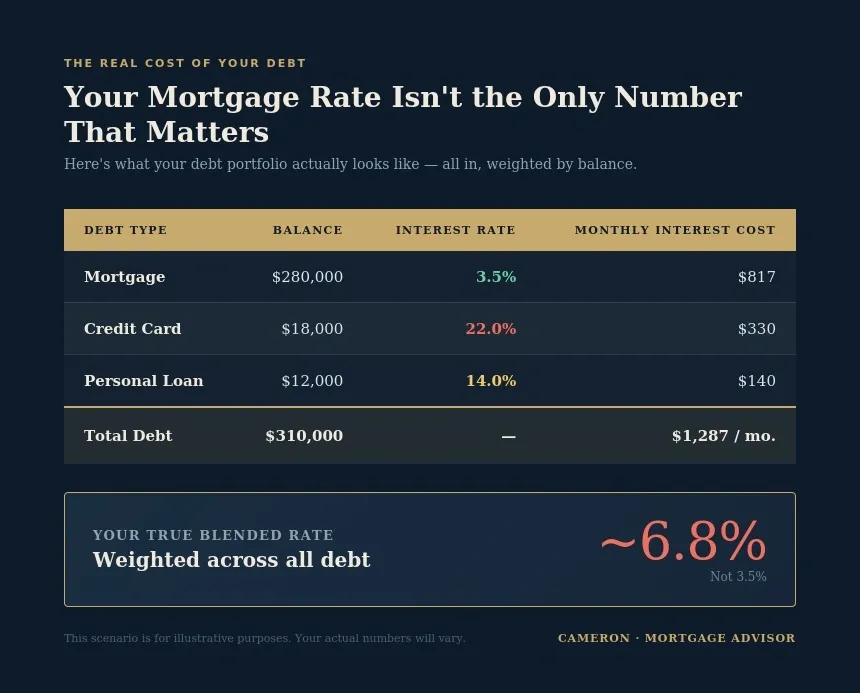
Your blended rate here isn't 3.5%. It isn't even close. Run the weighted math and you'll land somewhere around 6.5% to 7%, meaning your total cost of borrowing is already in or above today's mortgage rate territory, even with that "great" mortgage in the mix.
Want to calculate your own? Use this free blended rate calculator to plug in your actual numbers and see what you're really paying.
The Myth That's Costing You Money
The idea that a low mortgage rate is always worth protecting assumes that your mortgage rate is your only rate. For most American households, that's not the case.
According to the Federal Reserve, the average credit card interest rate sits around 21% as of early 2026, near historic highs. That's not a rounding error. That's a compounding machine working against you every single month.
Here's the math that should get your attention, and this part is something most people have genuinely never been told.
Credit Card Minimum Payments Are Not Designed to Pay Off Your Debt
Your mortgage is amortized. That means from day one, every payment you make is calculated on a defined schedule to reduce your balance to zero by a specific date. You know exactly when it will be paid off because the math is built that way.
Your credit card works completely differently.
Credit card minimum payments are typically calculated as a small percentage of your current balance, often 1 to 2%, or a flat dollar floor like $25, whichever is greater. There is no payoff schedule. No amortization. No finish line baked into the math. You're just making the smallest payment the card company will accept before charging you a late fee.
Here's where it turns into a trap.
At 22% APR, a $10,000 credit card balance accrues roughly $183 in interest every single month. If your minimum payment happens to be $180 that month, you are barely treading water, and some months, depending on how the minimum is calculated, you aren't even doing that.
In fact, if your minimum payment falls below the monthly interest charge, your balance will actually increase even though you made your payment on time. You did everything right and still went backwards. That's not a personal failure. That's how the product is mathematically structured.
This is the debt hamster wheel. And it's not just uncomfortable, it can become inescapable. A $10,000 balance at 22% interest, paid with minimum payments only, can take over 20 years to pay off and cost you well over $14,000 in interest alone, on top of the original $10,000 you spent. You pay more than double, over two decades.
Scale that to $25,000 or $40,000 in combined credit card and personal loan debt, which is increasingly common, and you are carrying an anchor that grows faster than most people can shovel against it. The minimum payment isn't a path to financial freedom. For many people, it's a path to staying in debt indefinitely.
Meanwhile, your 3.5% mortgage is sitting there looking virtuous, while 22% compound interest quietly dismantles your financial future one billing cycle at a time.
What Financially Savvy Homeowners Actually Do
Here's the mindset shift: your home equity isn't a prize to be hoarded. It's a financial tool.
Smart homeowners understand that equity sitting idle in a house isn't earning a return. It's just appreciating (hopefully) while high-interest debt compounds against them. The strategic move, when the math supports it, is to leverage low-cost home equity to eliminate high-cost unsecured debt.
A cash-out refinance lets you do exactly that. You refinance your existing mortgage into a new loan for a higher amount, take the difference as cash, and use those funds to pay off high-interest balances. The result:
- One monthly payment instead of five
- A weighted interest rate that's likely lower than your blended rate today
- Freed-up monthly cash flow
- No more 22% compound interest working against you
This is how people who understand money think about debt. They don't manage it emotionally, they manage it mathematically.
When a Higher Mortgage Rate Can Actually Save You Money
Let's make this concrete. Say you have a $280,000 mortgage at 3.5%, plus $30,000 in credit card and personal loan debt averaging 19% interest.
If you refinance into a $310,000 mortgage at 6.5%, your mortgage rate went up, but look at what happened to your overall financial picture:
- You eliminated roughly $500 to $600 a month in minimum payments on the consumer debt
- You traded 19%+ interest for 6.5% interest on that $30,000
- Your blended rate across all debt dropped significantly
- Your net monthly outflow likely decreased even with a higher mortgage payment
The math works because you're comparing a 3-point increase on your mortgage against a 12 to 15 point decrease on tens of thousands in high-interest debt. The mortgage rate is the loudest number. It's not the most important one.
The Honest Caveat: This Isn't for Everyone
I want to be straight with you here, because a lot of content out there will make this sound like a guaranteed win. It's not always.
A cash-out refinance to pay off consumer debt makes sense when:
- The math confirms your blended rate drops meaningfully
- You have sufficient equity, typically 20% or more remaining after the cash-out
- Closing costs don't wipe out the savings within your intended time horizon
- You address the spending behavior that created the debt in the first place
It's the wrong move when:
- You're likely to run the credit cards back up, because now you've converted unsecured debt into debt secured by your home
- You're planning to sell in the near term and can't recoup closing costs
- The rate environment makes the new mortgage payment genuinely unaffordable
This is exactly why a real conversation with a mortgage advisor, not just a calculator, matters. The numbers tell you what's possible. A good advisor tells you whether it's right for your situation.
Start With the Calculator, Then Let's Talk
If you've got a low mortgage rate and consumer debt you're carrying month to month, your first step is simple: find out what your blended rate actually is.
Click here to calculate your blended rate →
Plug in your balances and rates. If that number is higher than today's refinance rates, which for most people carrying significant credit card debt, it will be, we should talk. There may be a strategy that gets you more breathing room every month and saves you tens of thousands in interest over the life of your debt.
Your mortgage rate is not the whole story. Don't let it be the only number you're watching.